Describe the Process of Transcription in Protein Synthesis
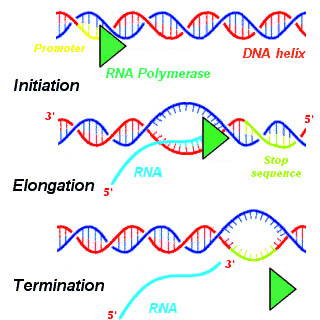
Transcription in Protein Synthesis Initiation. Only one strand of DNA is copied during the process of transcription known as the template strand and the RNA formed is called the mRNA.
Transcription Of Dna Stages Processing Teachmephysiology
In the wake of transcription the DNA strands re-form a double helix.
. These proteins are produced by the process of transcription and translation. Protein Synthesis Steps Process in Details Translation Initiation. The DNA strand used for the synthesis of RNA is called antisense or template strand which is.
The next phase in the transcription process is elongation. Since the DNA cannot leave the nucleus copies of the section needed to make the protein are made this is called transcription. The protein synthesis occurs in two steps namely transcription and translation.
Eventually the RNA transcript is released and. This control is possible through the transcription of mRNA. Transcription ends in a process called termination.
1st step of transcription. The process of transcription is as follows. In translation mRNA along with transfer RNA tRNA and ribosomes work together to produce proteins.
RNA polymerase binds to promoter site. This is a two-step process. It is one of the first processes in gene expression.
The process involves ribonucleic acid RNA deoxyribonucleic acid DNA and a set of enzymes. 9 What begins the process of transcription. The role of transcription could be to make sure that there are enough proteins present in order to maintain the rate at which they are produced.
Initiation Elongation and Termination. Ribosomes serve as a site for protein synthesis. Transcription begins when RNA polymerase binds to a promoter sequence near the beginning of a gene directly or through helper proteins.
Elongation of the polypeptide. The polymerase moves downstream unwinding the DNA and elongating the RNA transcript 5 to 3. The second step is translation in which the RNA molecule serves as a code for the formation of an amino-acid chain a polypeptide.
4 Where does DNA and RNA synthesis begin. Repressor C is produced when a cells DNA is damaged. The procedure of synthesizing mRNA templates from DNA molecules is called transcription.
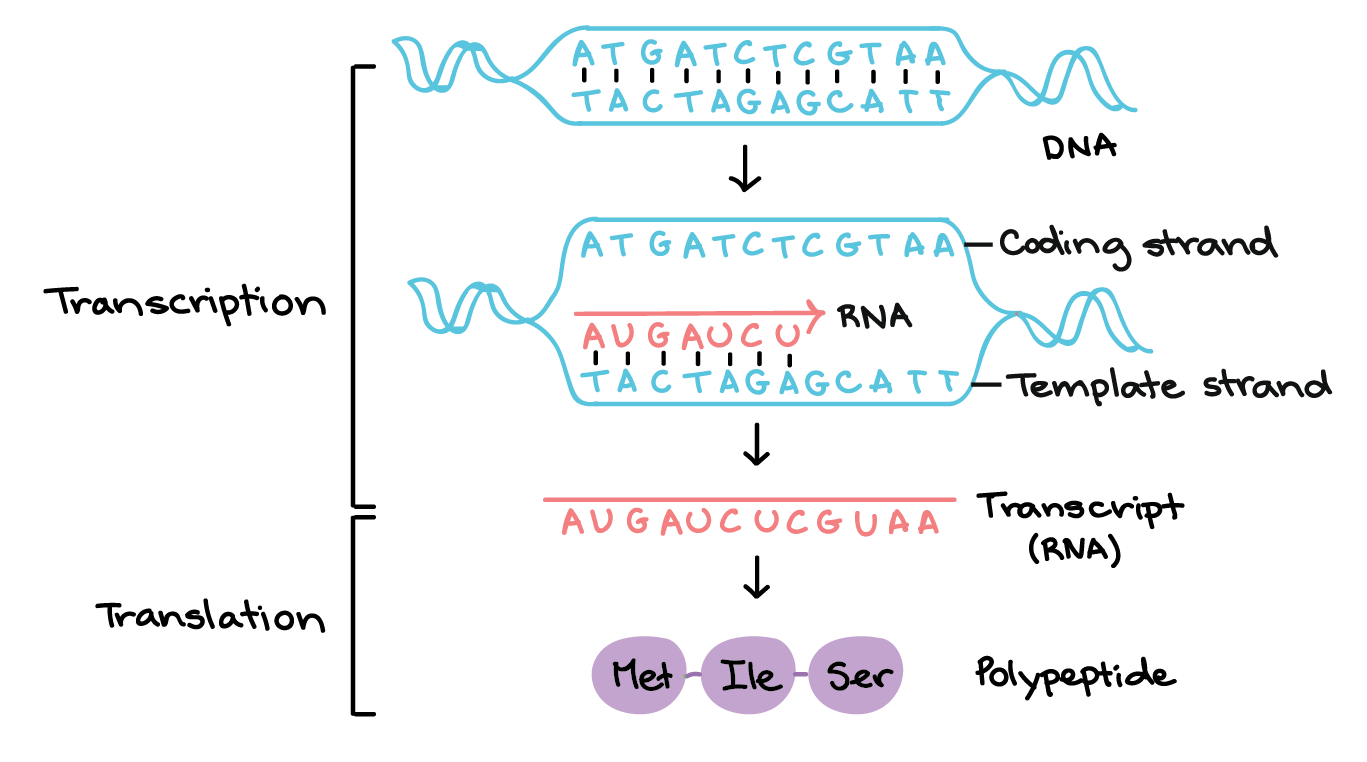
RNA polymerase uses one of the DNA strands the template strand as a template to make a new complementary RNA molecule. For transcription promoter structural gene and terminator together called transcription unit are required. Initiation requires two special protein groups.
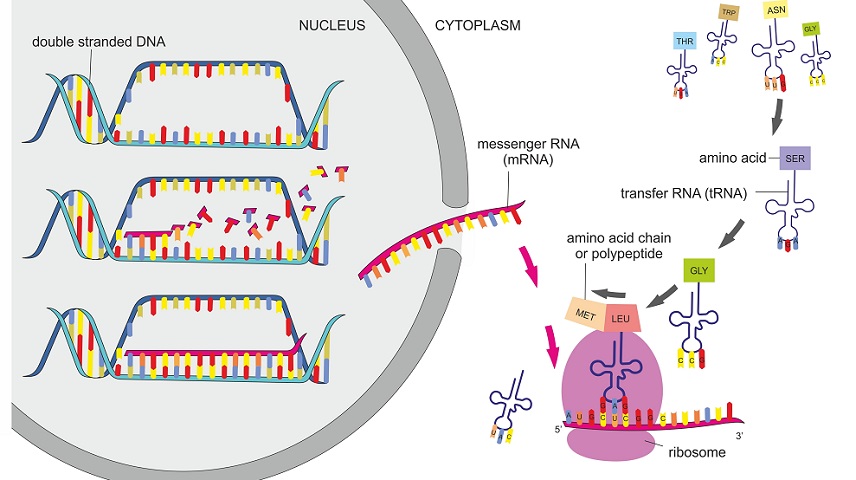
Transcription involves three stages viz. All types of ribonucleic acids namely messenger ribonucleic acid mRNA ribosomal ribonucleic acid rRNA and transfer ribonucleic acid tRNA are required for protein synthesis. This copy called a messenger RNA mRNA molecule leaves the cell nucleus and enters the cytoplasm where it directs the synthesis of the protein which it encodes.
Activator A is present only in skin cells. It then moves along the DNA and causes local unwinding of DNA duplex into two strands in the region of the gene. 7 Where is mRNA synthesized transcription or translation.
Describe the steps of transcription in bacteria. The first step is transcription in which the sequence of one gene is replicated in an RNA molecule. After DNA is transcribed into a messenger RNA mRNA molecule during transcription the mRNA must be translated to produce a protein.
Describe the steps of transcription in bacteria. For the creation of a new generation the genetic information stored in the DNA has to be transferred from one generation to another. 2nd step of translation.
Protein synthesis initiation is triggered by the presence of several initiation factors IF1 IF2 and IF3 including mRNA ribosomes tRNA. Taking apart of a product. During transcription the information from DNA is encoded into mRNA.
Cell uses the genes to synthesize proteins. During transcription DNA partially unwinds by the enzyme helicase. 8 Where the RNA polymerase and the newly formed mRNA are released.
Transcription Factors and Cellular Logic. The first group is transcription factors these recognize. DNA controls the synthesis of proteins having amino acids in a specific sequence.
A ring of carbon and nitrogen atoms the nitrogen can form a. Explain the ramifications to the process of transcription if spliceosomes excise exons and join the remaining introns together. Later these mRNA templates are used to translate them into amino acids.
Genetic code is specific for particular amino acids. 6 Where does the transcription take place. Proteins are crucial biomolecules involved in various cellular functioning.
Only antisense strand functions as template. Transcription is the process of copying DNA into messenger RNA which can then be translated into protein. During translation the mRNA works with a ribosome and tRNA to synthesize proteins.
The genetic information flows from DNA to protein and this flow of information takes place in a sequential process of transcription and translation. Transcription is the process of making an RNA copy of a gene sequence. 5 What is the segment of the DNA molecule that causes the synthesis of RNA to cease.
A phosphate group an acid a sugar in the case of DNA deoxyribose and. RNAs serve as intermediate molecules between DNA and protein. Labelling the ends helps us to describe in which direction DNA is read.
During translation the mRNA works with a ribosome and tRNA to synthesize proteins. The initiation of transcription requires that RNA polymerase recognize and bind tightly to a promoter sequence on DNA. The 5 end base pairs of one strand are always attached to the 3 end of the complementary strand.
The 3 main steps in transcription are initiation elongation and termination. Transcription takes place in the nucleus. During transcription the information from DNA is encoded into mRNA.
Protein synthesis comprises two major parts transcription and translation. Activator B is active only in cells receiving divide now signals growth factors from neighbors. With the coded sequence exposed RNAPs can read.
Protein synthesis is accomplished through a process called translation. Here is a more complete definition of transcription. Protein Synthesis The central dogma describes how the DNA makes its own copies by DNA replication then codes for the RNA by means of a transcription and RNA codes for the proteins by translation.
The protein synthesis occurs in two steps namely transcription and translation.

Protein Synthesis Ck 12 Foundation
Protein Synthesis The Definitive Guide Biology Dictionary
Stages Of Transcription Initiation Elongation Termination Article Khan Academy


Comments
Post a Comment